
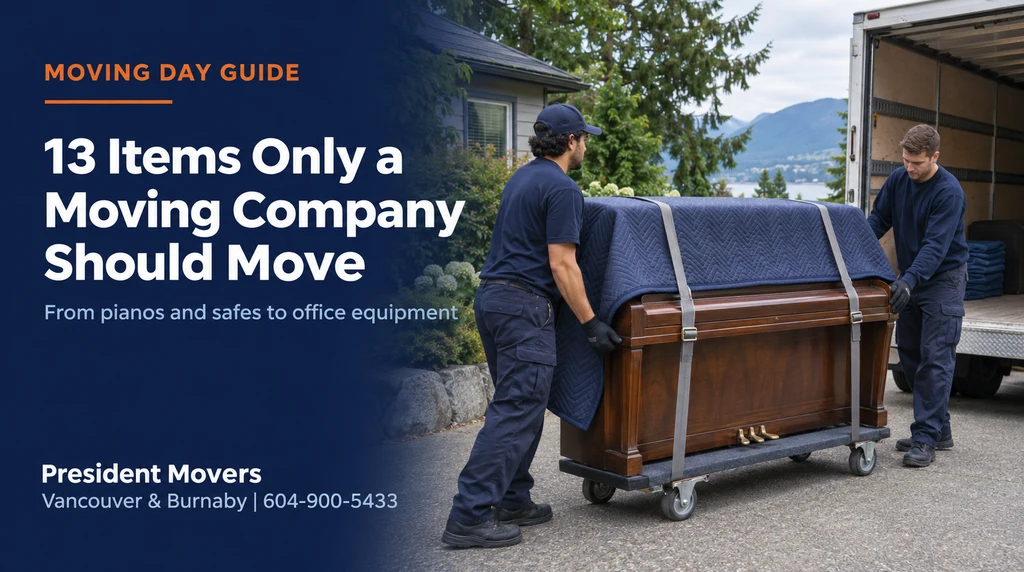
At President Movers, we help families and businesses move across Vancouver, Burnaby and the Lower Mainland.
In this guide, we list 13 home and office items that are safer in the hands of trained movers. For each one, we explain why it is hard to move on your own, how we handle it, and when you may also need a technician or tradesperson.
Quick List of Items Professional Movers Should Handle
| Item | Why it is hard to move | Who should help |
|---|---|---|
| Pianos | Heavy, top-heavy and easy to damage | Experienced piano movers |
| Pool tables | Heavy slate often needs disassembly and levelling | Movers plus a pool table technician |
| Safes and gun safes | Very heavy for their size and tip easily | Heavy-item movers |
| Washers and dryers | Heavy parts inside, water and gas hook-ups | Movers plus a gas fitter or plumber if needed |
| Fridges, freezers and stoves | Tall, wide and connected to water, power or gas | Movers plus a qualified tradesperson if needed |
| Large sofas and sectionals | Long and hard to turn in halls and stairs | Furniture movers |
| Wardrobes, bed frames and cabinets | Must come apart and go back together safely | Furniture movers or the maker’s installer |
| Antiques, art and large mirrors | Fragile, valuable or hard to replace | Movers with careful packing |
| Home gym equipment | Heavy frames, motors and weight stacks | Movers plus the maker’s installer if needed |
| Office servers and IT equipment | Fragile parts and business downtime | Commercial movers plus your IT team |
| Office furniture and filing cabinets | Heavy, bulky and must move on a tight schedule | Commercial movers |
| Shelving, racking and business equipment | Heavy, tall and often fixed to walls or floors | Commercial movers plus an installer if needed |
| Hot tubs and spas | Very large, with power and plumbing | Spa movers plus an electrician |
Please note: This list is our advice, not a legal rule. A moving crew lifts, wraps and transports your items. Gas, electrical and plumbing work, and jobs like levelling a pool table, are done by qualified tradespeople or technicians.
1. Pianos
Even a small upright piano is very heavy for its size, because most of the weight sits in a tight wooden case with a metal frame inside. Grand pianos are long and have legs, pedals and a lid that all need care.
Why it is risky to move a piano yourself
A piano can tip when it goes over a step, a door sill or a ramp. If it shifts suddenly, the people holding it can get hurt. Rough handling can also damage the legs, pedals or the parts inside. A normal home dolly is often not strong enough for this weight.
How we move a piano
- We ask for the piano type and size before moving day
- We check doorways, stairs and the path to the truck
- We wrap and pad the outside of the piano
- We use piano boards, straps and dollies made for the job
- We send enough crew for the weight and the stairs
- We tie the piano down securely inside the truck
Our single-item movers in Vancouver handle upright and baby grand pianos. Tell us the piano type, where it is now and where it is going, and we will plan the right crew.
A piano often needs tuning after a move. That is the job of a piano technician, so book one separately for a few weeks after it arrives.
2. Pool Tables
Many good pool tables have a slate top. Slate is a heavy stone, often cut into three pieces. To move the table, it must come apart, travel safely, and then go back together and be made level again.
What a pool table move involves
- Taking off the pockets and rails
- Removing the felt with care
- Lifting out and wrapping the slate pieces
- Taking apart the frame and legs
- Loading and moving all the parts
- Rebuilding the table at the new home
- Levelling the slate so the balls roll true
A table can look fine but still play badly if the slate is even slightly off level. Levelling and re-felting are often done by a billiards technician.
3. Heavy Safes and Gun Safes
A safe is heavy for its size and has very few places to grip. Many safes are tall and narrow, so they tip easily on steps, slopes and door sills.
Emptying a safe does not make it much lighter, because most of the weight is in the steel body. A heavy safe also puts a lot of weight on a small area of floor or stair.
What to tell us before you book
- The make and model, if you know it
- The weight listed by the maker
- The height, width and depth
- Whether it is bolted to the floor
- Where it is now (basement, upstairs, garage)
- How many stairs there are at each end
- Where it needs to go in the new home
Take out cash, papers and valuables and carry them yourself. Remove any firearms and ammunition before the crew arrives, arrange separate transport and follow the RCMP’s guidance for your firearm class.
Safety tip: Never stand below a safe on stairs, and never try to catch one that is tipping. Step away and let it fall.
4. Washers and Dryers
A washer has a heavy drum and motor inside. Both machines are wide and hard to grip, and laundry rooms are often small or in the basement. Stacked units are harder still, because the stacking kit must be taken apart the right way.
What can go wrong in a DIY move
- Losing control of the machine on the stairs
- Scratched floors or broken door frames
- Water left inside the drum or hoses
- Damaged water or drain hoses
- A loose drum getting damaged on the road
Many front-load washers need their transport bolts put back in before a move. Check your user manual, as each model is different.
Moving vs hooking up
We lift, wrap and transport the machines. Arrange for a licensed gas contractor to disconnect and reconnect a gas dryer. Ask the appropriate tradesperson about any specialized plumbing or electrical work.
Let us know if your washer and dryer are separate, stacked or a single combo unit, so we bring the right tools.
5. Fridges, Freezers and Stoves
Large fridges are tall, heavy and wide. French-door fridges and big freezers may not fit through a standard doorway unless the doors or handles come off. A fridge can also lean and tip when it is turned around a tight corner.
How to get them ready
- Empty and clean the fridge or freezer
- Defrost the freezer if your manual says to
- Take out or tape down loose shelves and drawers
- Turn off and disconnect the water line to the ice maker
- Arrange for a licensed gas contractor to disconnect a gas stove
- Tell us about stairs and narrow halls on both ends
Some makers say a fridge should stand upright for a set time before you plug it back in. Check your own manual for the exact steps.
We move the appliance after any gas, water or hardwired electrical connections are safely disconnected.
6. Large Sofas and Sectionals
A sofa has no gas lines or moving parts, but it can still be one of the hardest things in the house to move. It is long, heavy and has nothing to hold on to.
Our Burnaby movers often carry sofas through condo hallways, small elevators and tight townhouse stairwells. A sofa may fit through the front door and then get stuck at the first corner. Forcing it can tear the fabric, crack the frame and mark the walls.
How we help
- We measure the sofa and the whole path
- We split sectionals into their pieces
- We remove legs where we can
- We wrap the fabric to keep it clean and dry
- We plan each turn before we lift
Some sofas come apart easily, while others should only be taken apart by following the maker’s steps. Our furniture disassembly and assembly service covers beds, tables, wardrobes, desks and other pieces that are made to come apart. Send us photos of the sofa and the tightest spot on the route, and we will plan the move around them.
7. Wardrobes, Bed Frames and Large Cabinets
Many big pieces must come apart to fit through a door. Moving them fully built can also strain the joints, because they were not made to carry their own weight while being tilted.
What can go wrong
- Stripped screws
- Lost bolts and fittings
- Broken joints or cracked panels
- Wobbly furniture after it is rebuilt
Flat-pack and particleboard furniture is weakest at its joints and can break if it is taken apart too many times or lifted at the wrong spot. We bag and label the hardware for each piece and rebuild it at your new home. Our guide on whether moving companies take apart furniture explains what is usually included.
Some pieces need a specialist, such as Murphy beds, built-in units and cabinets fixed to the wall. Tall dressers and bookcases should also be anchored to the wall again after the move. Furniture and TVs can tip over and badly hurt young children who climb on them. Ask us whether re-anchoring is part of your job, and never assume it is.
8. Antiques, Art and Large Mirrors
Some items are hard to move not because they are heavy, but because they are fragile or cannot be replaced. Old furniture may have weak joints, thin wood veneer or loose trim. Large mirrors can crack from a small bump or a twist. Paintings can be harmed by pressure, damp air and the wrong packing.
How we pack fragile pieces
- We check and note the condition of each item first
- We use soft wrap, corner guards and padding
- We keep mirrors and framed glass standing on their edge
- We pack pictures in boxes made for them
- We place them in the truck where they will not shift or get crushed
Our packing and unpacking services cover fragile and valuable items. For very rare or high-value art, ask us whether a custom crate or art handler is a better fit.
Check your coverage first
Give your mover full details about special items and get your estimate in writing. A mover’s basic coverage may not pay the full value of a costly piece. Tell us the value before the move, ask what protection is available, and check your home or tenant insurance too. Taking photos of each item before the move also helps if you ever need to make a claim.
9. Home Gym Equipment
Treadmills, weight machines, ellipticals and exercise bikes are heavy, odd-shaped and full of parts. Many have motors, cables, weight stacks or tensioned springs. Some must be taken apart before they fit through a door or down the stairs.
Lifting a machine by its handlebars or screen can snap them. A machine can also shift without warning when it is tilted.
How to get gym equipment ready
- Fold and lock the treadmill if it is made to fold
- Take off loose weight plates and attachments
- Find the make and model, and the maker’s moving guide if there is one
- Tell us if it is in a basement, upstairs or in a garage
We move treadmills and other heavy gym machines as part of our single-item and household moves. Large multi-station machines may need the maker’s installer to take them apart and set them up again.
10. Office Servers and IT Equipment
An office move is different from a home move. Along with desks and filing cabinets, you may be moving servers, computers, network gear and printers. If any of it is damaged, or set up late, your business loses time and money.
Servers have hard drives and parts that do not like bumps. A loaded server rack can also be top-heavy and unsafe to roll.
Who does what
Your IT team should:
- Back up all data
- Shut down systems safely
- Label every cable and port
- Reconnect and test everything after the move
Our crew will:
- Pack and wrap screens, computers and hardware
- Lift and move desks, cabinets and workstations
- Load, move and place everything where you need it
Our commercial moving services cover offices, workstations and technology. To plan ahead, read our guide on how to move IT equipment safely during a business relocation. Pick one person from IT and one moving lead before the move, so everyone knows who is in charge of each step.
11. Office Furniture and Filing Cabinets
Desks, boardroom tables, filing cabinets and cubicle panels may look like ordinary furniture. But in an office, there are often dozens of them, and they all need to move in a short window, often after hours or over a weekend.
Why office furniture is hard to move
- Full filing cabinets are very heavy and can tip forward if a drawer slides open
- Large boardroom tables and L-shaped desks rarely fit through doors in one piece
- Cubicle panels and sit-stand desks have many small parts that are easy to lose
- Office towers often have booked freight elevators and set loading times
How we move office furniture
- We take apart desks, tables and workstations, and bag and label the parts
- We lock or tape filing cabinet drawers, and ask you to empty heavy ones first
- We wrap and pad every piece to protect it and the building
- We label each item with its room or desk number at the new office
- We set up the furniture so your team can sit down and start work
To keep downtime low, we offer after-hours and weekend moves. Tell us the timing that suits your business and your building’s rules when you request your quote.
12. Shelving, Racking and Business Equipment
Retail shops, warehouses and workshops often have steel shelving, storage racks, display units, safes and heavy machines. Many of these are tall, heavy and fixed to the wall or floor.
Why business equipment needs care
Tall shelving and racking can fall if it is loaded or taken apart in the wrong order. Bolts and anchors must be removed safely, and the parts must be kept together so the unit can be rebuilt the same way. Heavy machines may need a pallet jack, lift gate or special dolly to move at all.
How to get ready
- Empty all shelves, racks and display units before moving day
- Tell us which units are bolted to the wall or floor
- Share the make, model and weight of any heavy machines
- Arrange for a qualified person to take down and reinstall industrial storage racks covered by WorkSafeBC’s rules, including some racks below 2.4 m if they’re loaded or unloaded mechanically
- Arrange an electrician for any machine that is wired in
Send us your equipment list. We will look at it and tell you what we can move, what tools we will bring and where a specialist is needed.
13. Hot Tubs and Spas
A hot tub is one of the biggest items anyone moves. It is very heavy even when empty, it is wide, and it is tied into power and plumbing. Some backyards also have fences, decks or slopes in the way.
What a hot tub move involves
- Draining the tub fully
- Arranging for a licensed electrical contractor to disconnect a hardwired spa
- Checking the path for gates, decks and soft ground
- Using a spa dolly, trailer or crane if needed
- Placing it on a strong, level base at the new home
- Arranging for a licensed electrical contractor to reconnect a hardwired spa
Drain the tub and arrange to have it disconnected before transport. Send us the model, dimensions and photos of the route so we can confirm whether we can take the job or whether you’ll need a spa mover.
Moving Heavy Items in Vancouver and Burnaby
The same item can be easy to move from one home and hard to move from another. In the Lower Mainland, these are the issues we plan for most.
Condo Elevators and Strata Bylaws
Check your building’s strata bylaws and book the elevator if required. Measure the elevator doorway and cab as well as the suite door. A sofa or piano may fit through one and still be too long for the other.
Narrow stairs and halls
Older homes and townhouses often have tight turns and low ceilings. Measure the whole path, not just the front door.
Parking and loading
Downtown buildings may have loading bays, set moving hours or limited street parking. A long walk from the truck can change the crew size we send.
Rain
Wet weather makes ramps, steps and driveways slippery and can soak fabric and wood. We use covers and floor protection to reduce exposure to rain and keep entryways easier to work in.
We plan around these local issues every day through our Vancouver moving services and Burnaby moving services.
How to Get Heavy Items Ready for Moving Day
- List every heavy or special item – Don’t call a piano “furniture” or a safe “one big box.” Tell us exactly what it is.
- Take photos – Show the item and the path, including doors, stairs, halls and tight turns.
- Find the make and model – This helps us check the weight and the maker’s moving steps.
- Measure the path – Check the width and height of doors, halls, stairs and elevators.
- Book tradespeople early – Arrange for a licensed gas contractor or the appropriate tradesperson for any specialized plumbing or electrical work.
- Check your written quote – Ask for an itemized breakdown covering labour, stairs, specialty handling, disassembly, reassembly and any equipment charges.
- Ask about coverage – Tell us about valuable items and ask what protection applies.
- Clear the new spot – Make sure the place where the item will go is empty and ready.
- Let the crew do the lifting – On moving day, please don’t jump in to help with a heavy lift. A planned lift is safer when only the trained crew is involved.
Do You Need a Full Move for Just One Item?
No, you don’t need to book a whole house move to get help with one heavy item. We often help with jobs like:
- A piano bought from someone else
- A fridge going to a new home
- A safe going down to a basement
- A treadmill going upstairs
- A second-hand sectional sofa
- An antique cabinet going to a family member
Our single-item moving service is made for these jobs. Send us the item details, and we will confirm whether we can take it on, what it needs and what it will cost.
Let President Movers Handle Your Heavy Items
When an item is heavy, fragile or hard to move through your home, it is worth handing it to a trained crew. Tell us about your difficult items first, and we will plan the right crew, tools and steps for moving day.
Get a free moving quote or call President Movers at 604-900-5433.
Frequently Asked Questions
What items should only professional movers move?
At home, the main ones are pianos, pool tables, safes, large appliances, big sofas, antiques, art, gym machines and hot tubs. At work, they are servers, office furniture, filing cabinets, shelving and heavy business equipment. These items are heavy, fragile or hard to move through tight spaces. Some also need a technician or tradesperson along with the movers.
Can you move a piano?
Yes, we move upright and baby grand pianos. For a larger grand or a difficult route, send us the model and access details so we can confirm whether we can take the job.
Can movers take apart and rebuild a pool table?
For a slate table, confirm who will disassemble, transport, reassemble and level it before you book. You may need a billiards technician for the setup.
Can you move a gun safe?
We can assess an empty safe once we know its weight, dimensions and access. Remove any firearms and ammunition and arrange separate transport in line with the RCMP’s guidance.
Can you move an office after business hours?
Yes, we offer after-hours and weekend office moves, so your team loses as little work time as possible. Tell us your preferred timing and any building rules when you ask for a quote.
Is it worth hiring movers for just one heavy item?
Often, yes. One piano, safe or large fridge can be harder to move than a room full of boxes. Trained movers lower the risk of injury and damage to the item and your home.
How much extra does it cost to move a heavy item?
The cost depends on the item’s weight and size, access at both addresses, travel distance and any special equipment or crew needed. Request an itemized written quote. Changes to the items, stops or scope can affect the final price.